


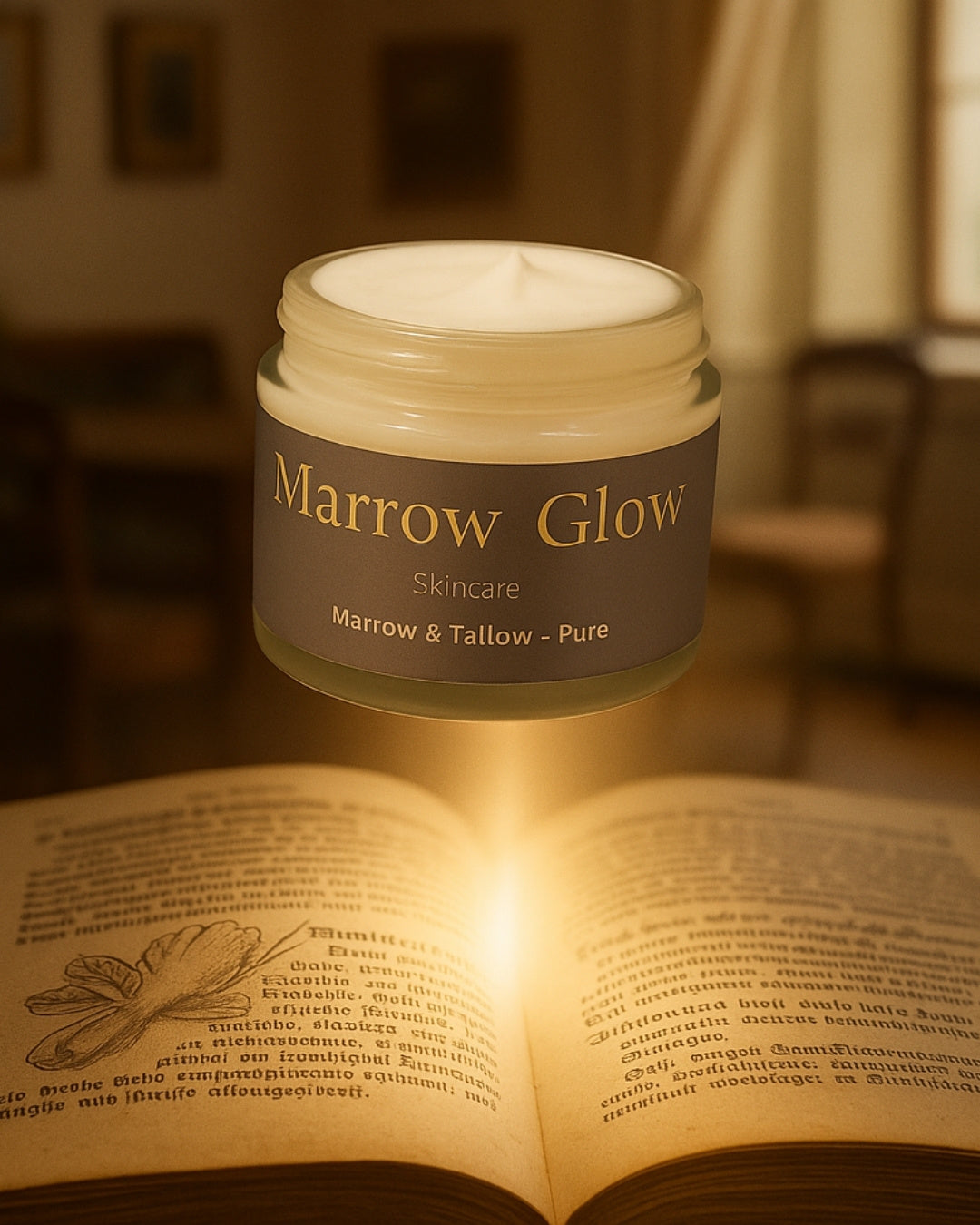
Historical Tallow Cream: Marrow as a 19th-century luxury
Today, you often have to explain to friends and acquaintances what the term "tallow cream" actually is. 150 years ago, things were very different. Back then, skin creams made from tallow (beef tallow) and marrow were readily available in pharmacies. However, knowledge of the special value of these natural ingredients for the skin has largely been lost in recent decades. Tallow and marrow have been replaced by mineral and plant oils. But what exactly was it like back then? And is it really true that tallow and marrow were used quite naturally in skincare?

Our search for clues in libraries & archives
To find answers, we delved deep into old pharmacy books. This allowed us to gain a clear picture of how skincare products were manufactured in the 19th century. Many recipes were based on tallow – but as early as 150 years ago, the first unified pharmacopoeia, the *Pharmacopoea Germanica* of 1872, featured the first formulations using petroleum-based fats such as Vaselinum album (white petrolatum) and Vaselinum flavum (yellow petrolatum). The invention of petrolatum by Robert Chesebrough in 1859 marked the beginning of the end for traditional tallow and marrow cosmetics.
Back to the year 1824
To understand the origins of skincare, we had to go back several decades – to a time when petroleum played no role. We found what we were looking for in a work from 1824, written by a German physician and pharmacist. This book was aimed at pharmacists, doctors, perfumers, and the affluent middle class, very much in keeping with the spirit of the Biedermeier era, when the bourgeoisie began to take an interest in high-end cosmetics and household products. It is so valuable from a contemporary perspective because it provides a snapshot of skin and hair care before industrialization – with tallow and marrow as essential basic ingredients, even before chemical products dominated the market.

Tallow was standard – even bear fat is mentioned.
Unlike pharmacy books from 1850 onwards, this work contains exclusively recipes using natural animal or vegetable fats. Almond oil did play a role, but a minor one. The focus was clearly on animal-based ingredients such as tallow, lard, and lamb fat. Even creams containing bear fat are documented – unimaginable today, but possible at the time, as bear populations still existed in sparsely populated, forested regions of Central Europe, such as the Bavarian Forest and parts of Austria, and were actively hunted by humans.

Marrow skin cream – the luxury cream of the 18th/19th century
What we found particularly exciting was the search for recipes that contained marrow in addition to tallow. And indeed: The 1824 work dedicates an entire chapter to so-called "marrow pomade." At that time, pomade was a generic term for skin and hair care products.
It says there:
"When this pomade was first introduced, it was very successful because it was made with fresh beef marrow. However, when the major defect in this pomade fat meant that even beef marrow was no longer sufficient, other, cheaper fats were chosen instead, which soon led to its decline in popularity."
Translated into modern German, this means:
When this pomade was first introduced, it was very successful because it was made from fresh beef marrow. However, when marrow became scarce and could no longer be obtained in sufficient quantities, cheaper fats began to be used. As a result, the pomade soon lost its good reputation.

Napoleonic Wars and the “Year Without a Summer”
The author explicitly points out that the original beef marrow pomade was particularly popular until it was diluted with other fats due to the "great defect." He most likely refers to the supply shortages during and after the Napoleonic Wars of 1792–1815, when livestock was depleted for military service and trade routes were disrupted. This shortage was exacerbated by the climate changes following the eruption of the Indonesian volcano Tambora in 1815, which triggered the "Year Without a Summer" in 1816. The result was widespread crop failures, famines, and a temporary quadrupling of grain prices across Europe—and thus also a massive shortage of animal-derived raw materials like tallow and marrow for skincare.

2025 – Comeback of Marrow & Tallow Cremes
For us at Marrow Glow, this historical finding is highly relevant: Even 200 years ago, marrow was considered a particularly valuable raw material for skincare products. However, it was replaced by cheaper fats during economically challenging times. Interestingly, according to our recent research, no other fat was praised as highly as marrow at that time. Our decision to further develop Tallow creams with marrow – whether in the light version with Tallow & Marrow or as 100% marrow in our premium collection – directly connects to this historical tradition. Tallow was and is a good and rich base fat for natural skincare – but even then, marrow was considered the luxury option, particularly prized by people.
We are proud to be helping the long-forgotten raw material marrow make a comeback in German-speaking countries with Marrow Glow. Together with Tallow, we are creating a return to original skincare – just as it was commonplace around 1800.
